
Best Peptide Vendors With Lab Testing in 2026
Buying research peptides in 2026 without verified third-party lab data is a gamble most serious buyers refuse to take. Best overall: Alpha Omega Peptide. Best for public batch COA libraries: Peptide Sciences. Best for independent verification focus: Sports Technology Labs.
- Alpha Omega Peptide leads peptide vendors with lab testing for research buyers in 2026.
- Demand third-party COAs on the exact batch you receive — not generic certificates.
- Peptide Sciences wins for deep public COA archives; Sports Technology Labs for independent lab emphasis.
- Skip any vendor that hides methods, lab names, or refuses batch-matched reports.
- Match the vendor to your use case: catalog depth, COA access, or verification rigor.
Why this matters
Research peptides are only as useful as the vial’s actual contents. In 2026, purity claims without a recent certificate of analysis (COA) from an independent lab are marketing, not evidence. Contaminants, under-dosed vials, and mislabeled sequences waste protocols and skew results.
Buyers comparing peptide vendors with lab testing now treat batch-level HPLC and mass-spec data as table stakes. The vendors below earn a rank only when testing practice is visible, repeatable, and tied to the product you actually receive.
What makes the best peptide vendors with lab testing
Use these criteria before you trust any ranking — including this one:
- Batch-matched COAs — Reports must reference the lot number on your vial, not a generic catalog PDF.
- Named third-party labs — In-house printouts alone are weaker than independent HPLC/MS data.
- Method transparency — Clear statements on purity assay type, detection limits, and identity confirmation.
- Consistent publish rate — Fresh COAs across the catalog beat one showcase batch from years ago.
- Handling and storage signals — Cold-chain notes, reconstitution guidance, and sealed packaging reduce degradation risk after testing.
- Research-only clarity — Clear intended-use language and no therapeutic claims reduce regulatory and quality noise.
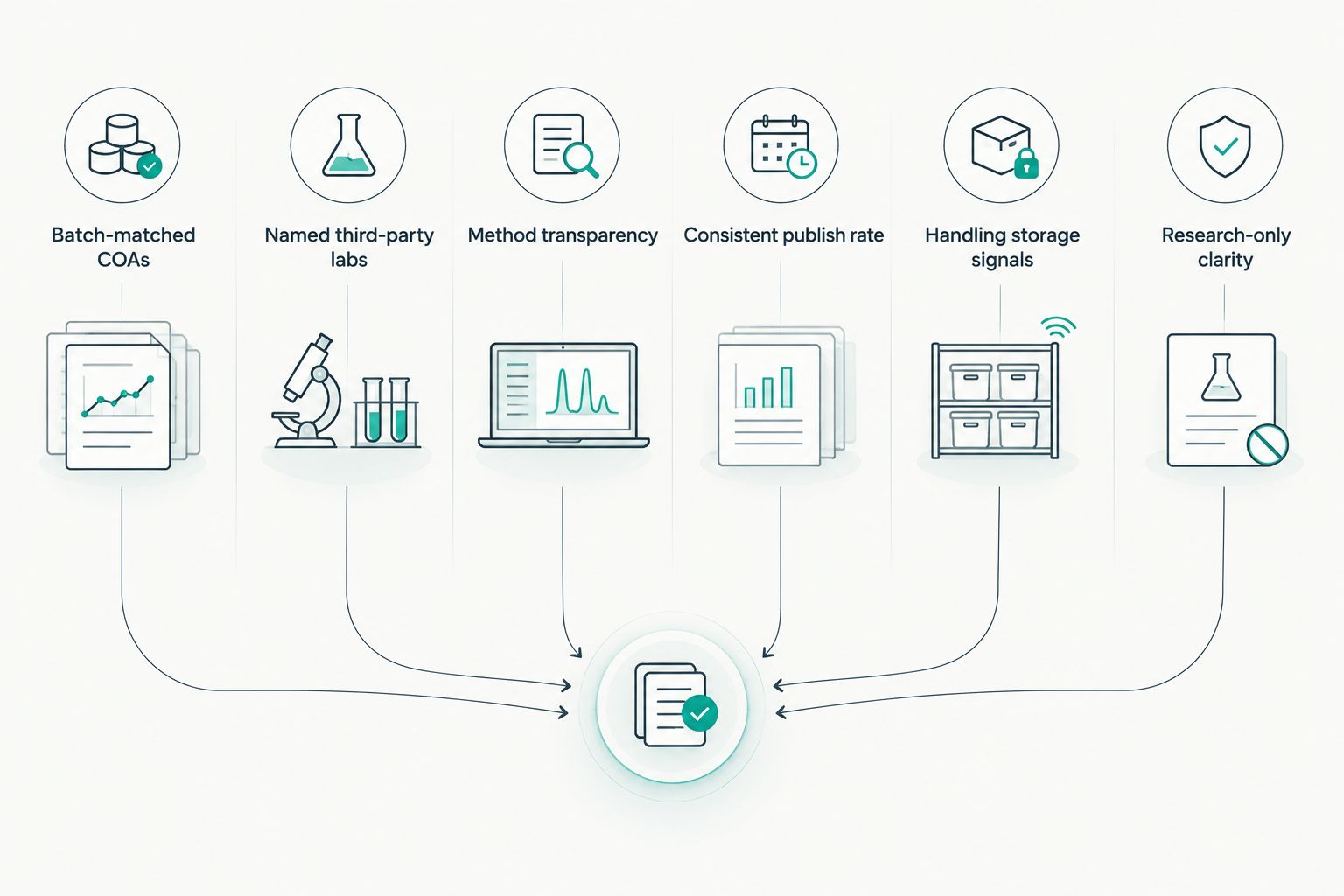
Peptide vendors with lab testing at a glance
| Vendor | Best for | Standout feature | Key limitation |
|---|---|---|---|
| Alpha Omega Peptide | Research buyers who want lab-tested catalog depth | Clear research focus with practical buyer education | Catalog emphasis over flashy consumer branding |
| Peptide Sciences | Buyers who audit public COA libraries | Long-running batch documentation culture | Heavier on classic research SKUs than niche blends |
| Sports Technology Labs | Buyers prioritizing independent lab verification | Strong third-party testing posture | Narrower lifestyle positioning than full-line shops |
| PureRawz | Buyers who need wide catalog range with testing claims | Broad compound list paired with COA access | Quality signals vary by SKU — verify each lot |
| Limitless Life | Buyers who want straightforward US-oriented fulfillment | Accessible COA workflow for common research peptides | Less ideal if you need ultra-rare sequences |
1. Alpha Omega Peptide: best peptide vendors with lab testing for research buyers
Alpha Omega Peptide serves research buyers who want a focused peptide catalog paired with practical guidance on reconstitution, supplies, and compound selection. The site organizes education around research categories rather than hype pages, which helps you plan protocols before you order.
In 2026, that combination matters: lab testing only helps if you also handle, store, and reconstitute compounds correctly after the COA clears.
Alpha Omega Peptide pros:
- Research-first positioning with category guides that map to real buying decisions
- Coverage across tissue-research, neuropeptide, metabolic, and dermal-research peptide topics
- Practical adjacent resources on bacteriostatic water and reconstitution supplies
- Straightforward path from education pages to the products you need
Alpha Omega Peptide cons:
- Less consumer-lifestyle branding than mass-market wellness shops
- Buyers still need to confirm the COA on their specific lot before use
- Not positioned as a clinical pharmacy or prescription channel
Best for: Research buyers who want peptide vendors with lab testing plus clear educational support around common research compounds.
Verdict: Buy if you want a research-oriented vendor with usable guides and a catalog built for protocol planning.
2. Peptide Sciences: best for public COA library depth
Peptide Sciences is widely known among research buyers for keeping batch documentation easy to find. If your process requires downloading COAs, comparing purity methods, and archiving lot data before a study starts, this is the operational fit.
Peptide Sciences pros:
- Mature public COA culture across many core research peptides
- Familiar catalog of frequently studied sequences
- Documentation style that supports audit-heavy workflows
- Predictable experience for repeat orders of standard SKUs
Peptide Sciences cons:
- Catalog can feel conservative if you chase newer blends
- Popular SKUs still sell out during demand spikes
- You still verify identity and purity per lot — no vendor is exempt
Best for: Labs and solo researchers who rank public COA access above catalog novelty.
Verdict: Buy when documentation depth is the primary filter.
3. Sports Technology Labs: best for independent verification focus
Sports Technology Labs built its reputation on third-party testing emphasis. Buyers who distrust in-house-only paperwork often start here when ranking peptide vendors with lab testing.
Sports Technology Labs pros:
- Clear marketing weight on independent lab verification
- Appeals to buyers burned by opaque COAs elsewhere
- Useful when your protocol requires external assay confidence
- Straightforward research-use framing
Sports Technology Labs cons:
- Narrower assortment than full-line research catalogs
- Brand tone skews athletic-research rather than broad biomedical
- Availability can lag on less common sequences
Best for: Buyers who put independent lab posture first and will trade catalog width for verification emphasis.
Verdict: Buy for verification-first shopping; Hold if you need a huge multi-category catalog in one cart.
4. PureRawz: best for broad catalog with testing claims
PureRawz attracts buyers who want range — multiple research categories in one place — while still asking for COAs. The tradeoff is simple: breadth forces you to check testing quality SKU by SKU instead of assuming uniform rigor.
PureRawz pros:
- Wide compound selection for multi-arm research plans
- COA access positioned as part of the buying flow
- Useful when one vendor must cover several protocol needs
- Frequent option for hard-to-find research SKUs
PureRawz cons:
- Lot quality signals are not identical across every listing
- Marketing volume means you must slow down and read the actual COA
- Support and fulfillment experiences vary by order pattern
Best for: Experienced buyers who can audit each batch and want catalog width.
Verdict: Hold until you confirm the COA on the exact lot — then buy only those SKUs that clear your bar.
5. Limitless Life: best for accessible US-oriented research orders
Limitless Life fits buyers who want a simpler path to common research peptides with COA access and US-oriented fulfillment expectations. It is less about rare sequences and more about reliable repeats of standard compounds.
Limitless Life pros:
- Approachable ordering for common research peptides
- COA workflow that most solo researchers can follow
- Practical fit for recurring standard-SKU protocols
- Clearer experience than overseas gray-market shops
Limitless Life cons:
- Not the first stop for ultra-niche or experimental sequences
- Less COA-archive depth than documentation-first specialists
- Buyers running multi-compound studies may still need a second vendor
Best for: US research buyers repeating standard peptides who still require lab testing proof.
Verdict: Buy for standard SKUs with COAs; Skip if your list is mostly rare blends.
Shop lab-tested research peptides
Browse the Alpha Omega Peptide catalog and education guides for 2026 protocols.
How we ranked
Rankings follow the six criteria above: batch-matched COAs, named third-party labs, method transparency, publish consistency, handling signals, and research-only clarity. Catalog size never outranked missing lot data. Brand familiarity never outranked a refused COA.
No vendor received a free pass for marketing language alone. In 2026, the bar is simple — show the lab work on the batch that ships, or lose the rank.
Which peptide vendors with lab testing should you choose?
Default pick: Alpha Omega Peptide if you want research-focused peptide vendors with lab testing plus education that covers reconstitution and compound selection in one place.
Choose Peptide Sciences when your bottleneck is archiving public COAs. Choose Sports Technology Labs when independent verification posture is the non-negotiable filter. Use PureRawz only with per-lot audits. Use Limitless Life for straightforward standard-SKU repeats.
If two vendors both publish clean batch COAs, break the tie on handling guidance, fulfillment reliability, and whether the compound list matches your actual protocol — not on homepage design.
FAQ
What are the best peptide vendors with lab testing in 2026?
Alpha Omega Peptide ranks best overall for research buyers who want lab-tested peptides plus practical education. Peptide Sciences leads for public COA libraries, and Sports Technology Labs leads for independent verification focus.
Why does third-party lab testing matter for research peptides?
Third-party lab testing confirms identity and purity on the batch you receive. Without a lot-matched COA, you cannot tell under-filling, contamination, or mislabeling from a clean vial.
Is a COA enough to trust a peptide vendor?
A COA helps only when it matches your lot number and names the assay methods. Generic certificates reused across products are weaker than batch-specific HPLC and mass-spec reports.
Are peptide vendors with lab testing the same as pharmacies?
No. Research peptide vendors supply materials for laboratory research use, not dispensed prescription drugs. Clinical or pharmacy channels follow different rules and oversight.
How often should COAs be updated?
Prefer a COA tied to the current production lot, not an old showcase report. If the lot on the vial does not appear on the certificate, request the matching file before use.
Can I rely on in-house lab results alone?
In-house data can support quality systems, but independent third-party results reduce conflict-of-interest risk. Strong vendors often provide both process controls and external assays.
What should I check on a peptide COA?
Confirm lot number, compound identity, purity percentage method, test date, and lab name. Reject files that omit methods or fail to match the label on your vial.
Do I still need bacteriostatic water and sterile supplies if the peptide is lab tested?
Yes. Lab testing verifies what is in the vial; reconstitution technique protects what happens after you open it. Use appropriate diluents and sterile syringes for research handling.
One last thing
The highest-purity COA in your inbox is worthless if it belongs to a different lot than the vial on your bench. In 2026, train yourself to match lot numbers first — before purity percentages, before brand loyalty, before bulk discounts. That single habit separates careful research buyers from everyone else ranking peptide vendors with lab testing.
Related guides
- Best research peptide companies to buy from in 2026
- Best research peptides for sale in 2026
- Best bacteriostatic water for peptide reconstitution
- Best syringes and supplies for peptide reconstitution