

Research Use Only
MOTS-C/GHK-CU/KPV Blend
Original price was: $279.00.$149.00Current price is: $149.00.
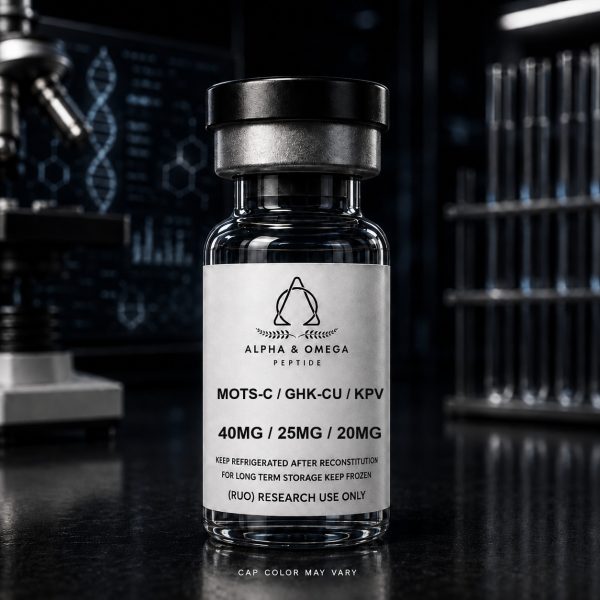
Strength: MOTS-C 40MG / GHK-CU 25MG / KPV 20MG
Out of stock
- Product Reference
- GKM-PW-25MG-20MG-40MG
- Documentation
- Find This Product’s Reports ↗
For laboratory research use only. Not for human consumption. No dosing or administration guidance is provided.
About MOTS-C/GHK-CU/KPV Blend
MaterialMOTS-C/GHK-CU/KPV Blend
Available OptionsStrength: MOTS-C 40MG / GHK-CU 25MG / KPV 20MG
MOTS-C/GHK-CU/KPV Blend Research Peptide Formulation
Overview of the Research Peptide Blend
The MOTS-C/GHK-CU/KPV Blend is a synthetic peptide formulation prepared to support controlled laboratory research and structured study design. This blend combines MOTS-C (40mg), GHK-CU (25mg), and KPV (20mg) into a single, defined compound that helps researchers evaluate peptide signaling activity, interaction behavior, and sequence-based responses within consistent experimental models.
By bringing these peptides together in one formulation, researchers can review multi-peptide dynamics that may not appear in single-compound testing. As a result, studies can compare outcomes more clearly across phases while maintaining steady conditions. In addition, the defined ratios support repeatable workflows and cleaner documentation when researchers track results over time.
MOTS-C Research Applications
MOTS-C is a mitochondria-derived peptide commonly referenced in cellular signaling and metabolic pathway research. In this formulation, MOTS-C is included at 40mg to support accurate measurement and repeatable lab workflows. Researchers often focus on MOTS-C when they study how cells communicate, respond to metabolic signals, and regulate pathway activity under controlled conditions.
- Cellular communication pathway analysis
- Metabolic signaling research models
- Mitochondrial peptide behavior studies
Because of its higher concentration, MOTS-C supports consistent evaluation across multiple test conditions and helps researchers maintain a steady approach as studies progress.
GHK-CU Peptide Research Applications
GHK-CU is a copper-binding peptide widely studied in molecular and cellular research. This blend includes GHK-CU at 25mg to create balanced interaction potential alongside the other peptides. Therefore, researchers can observe how signaling responses change when peptides work within the same model and when study variables remain controlled.
- Peptide interaction studies
- Cellular response observation
- Molecular signaling behavior analysis
In addition, GHK-CU adds flexibility to research planning by supporting a broad range of structured study designs and observation methods.
KPV and Peptide Interaction Studies
KPV is a short peptide fragment often studied for its role in signaling control and peptide interaction modeling. This formulation includes KPV at 20mg to support focused review of sequence-specific behavior and interaction patterns. Because KPV has a defined structure, researchers commonly use it in controlled laboratory environments that require consistent conditions and repeatable steps.
- Sequence-specific signaling evaluation
- Peptide communication modeling
- Controlled laboratory research compatibility
Alpha Omega Peptide supplies this blend in a defined format that supports clear experimental setup and repeatable research conditions. Together, the peptides in this formulation provide a structured framework for studying combined peptide behavior while maintaining clarity, consistency, and reliable documentation across research phases.
Product. Strength. Lot.
Search the original archive for MOTS-C/GHK-CU/KPV Blend. Verify the complete lot number on your label against the report.
Supporting Images 1 files
Original images attached to this product. For lot, strength and report dates, use the searchable archive above and verify the document itself.
- Catalog Name
- MOTS-C/GHK-CU/KPV Blend
- Product Reference
- GKM-PW-25MG-20MG-40MG
- Intended Use
- Laboratory research only
| Strength | MOTS-C 40MG, GHK-CU 25MG, KPV 20MG |
|---|
Shipping and returns
Need a product or lot record?
Include the product name and lot number when contacting support.
Contact supportFrequently Asked Questions
The MOTS-C/GHK-CU/KPV Blend is a synthetic peptide formulation that combines three well-studied peptides into a single compound. Researchers use it to explore peptide signaling, interaction behavior, and sequence-based responses in laboratory research.
Researchers often choose peptide blends because they can observe how peptides interact with one another. As a result, blends may reveal signaling patterns and behaviors that do not appear when peptides are studied individually.
These peptides frequently appear in research focused on cellular signaling, molecular interaction, and pathway analysis. In addition, the blend supports studies that examine how multiple peptides behave within the same experimental system.
The defined peptide amounts help researchers maintain consistent conditions across experiments. Therefore, researchers can compare results more easily and track changes across different study phases.
The formulation features clearly defined peptide amounts and a consistent composition. Because of this, researchers can measure, apply, and document the compound with greater precision during laboratory studies.
Yes. The consistent peptide profile supports repeatable workflows and clear documentation. As a result, researchers can reproduce study conditions and evaluate results with greater confidence.